

A nitrogen generator is a system that extracts nitrogen gas from the ambient air. The air is first purified and then passed through a membrane or adsorbent to remove the oxygen and produce pure nitrogen.
The use of a nitrogen generator offers numerous advantages over conventional gas supply. Firstly, it is more cost-effective as expensive gas supplies are no longer required. Secondly, it enables greater flexibility, as nitrogen gas can be generated directly on site. This means that production processes can be adapted at any time without having to rely on external supplies.


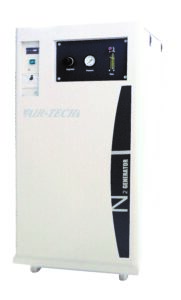
Functionality and application
Membrane method
In this process, gases are separated via membranes based on their size and/or affinity. The achievable purity of oxygen-nitrogen separation via membranes does not reach the purity of the cryogenic Linde process. If a lower purity or even just the enrichment of one component – such as oxygen in the breathing air – is sufficient, the membrane process represents an energy and cost-saving alternative. For example, a purity of 99.5 % is often sufficient for nitrogen, and it is currently estimated that 30 % of nitrogen requirements are covered by membrane technology. Membranes are also used in the separation of carbon dioxide and nitrogen/hydrogen. Membranes made of multiblock copolymers, consisting of polyethylene glycol (PEG) and polyamide (PA), are easily and quickly permeable to carbon dioxide, while they only have a very low permeability for nitrogen and hydrogen. These recently developed membranes could be used in the so-called “emission-free power plant”.
Advantages
Nitrogen is an indispensable aid necessary for oxygen to sustain life on Earth. Due to its diverse properties, which make it ideal for numerous industrial applications, nitrogen offers much more than just its role in maintaining life. The most significant characteristic of nitrogen is its inertness, which means it reacts only slowly with other substances. This makes it ideal for applications where slow oxidation (such as the corrosion of circuit boards in the electronics industry) or rapid oxidation (such as explosions or fires) needs to be prevented. Additionally, nitrogen is odorless and colorless, making it particularly suitable for use in the food and beverage industry, for instance, to extend the shelf life of products. Given these properties, it is hardly surprising that nitrogen is in constant demand across many industries, from automotive and chemical to aquaculture and injection molding.