

Industrial Viscosity Measurement with proRheo Covimat
Monitor viscosity directly in your production process – continuously and without routine manual sampling.
The proRheo Covimat 205 series consists of industrial rotational viscometers for continuous viscosity measurement and process monitoring. Depending on the model, viscosity can be measured directly in flowing media, production lines or mixing vessels. Continuous measurement provides valuable information about process conditions and helps manufacturers detect viscosity changes during production. The Covimat measuring principle is based on a rotating measuring body. Selectable rotational speeds and measuring geometries allow the system to be adapted to different materials and viscosity ranges. Continuous process measurement can support stable manufacturing conditions, reduce routine sampling and provide measurement signals for integration into industrial control systems.
Covimat 205 – Three Solutions for Industrial Viscosity Monitoring
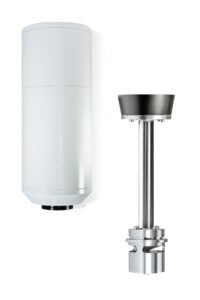
Covimat 205 DC – Inline Measurement Under Pressure and at High Temperatures
For continuous viscosity monitoring in flowing industrial processes.
The Covimat 205 DC is a rotational inline viscometer designed for viscosity measurement in flow-through measuring cells.It is particularly suitable for applications in which viscosity must be monitored under elevated pressure or at high process temperatures. Depending on the measuring cell and configuration, the Covimat 205 DC supports product temperatures up to 300 °C and process pressures up to 170 bar.Interchangeable measuring bodies allow adaptation to different viscosity ranges.
Documented viscosity range: 9–72,000 mPa·s, depending on the measuring body.
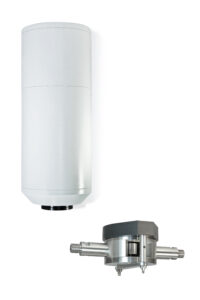
Covimat 205 DD – Inline Viscosity Measurement for Paints and Coatings
For continuous viscosity monitoring of low-viscosity materials.
The Covimat 205 DD is a rotational inline viscometer specifically developed for low-viscosity fluids and applications in paint and coating production. The closed measuring cell uses a magnetic coupling and can be integrated into suitable production and circulation systems. Different measuring elements allow the instrument to be adapted to the required viscosity range. The system is especially suited to applications in which viscosity monitoring contributes to consistent coating and processing conditions.
Documented viscosity range: 1–13,200 mPa·s, depending on the measuring system.
Maximum flow rate: 5 L/min.
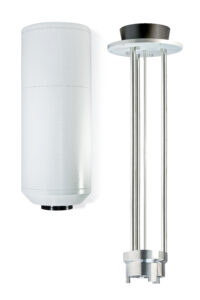
Covimat 205 TO – Continuous Viscosity Measurement in Tanks and Vessels
For viscosity monitoring directly inside production vessels.
The Covimat 205 TO is a rotational immersion viscometer for continuous viscosity measurement in unpressurized tanks and mixing vessels. The measuring system consists of a vessel-mounted assembly with a measuring body immersed in the product. By selecting a suitable measuring body and rotational speed, the instrument can be adapted to different viscosity measurement requirements. The Covimat 205 TO is particularly suitable for monitoring viscosity during mixing, blending, preparation or storage processes.
Documented viscosity range: 2–35,800 mPa·s, depending on the measuring body.
Maximum product temperature: 65 °C.
Covimat 205 – Technical Comparison
| Specification | Covimat 205 DC | Covimat 205 DD | Covimat 205 TO |
|---|---|---|---|
| Primary application | Pressurized flow processes | Paints and coatings | Tanks and vessels |
| Measurement principle | Rotational | Rotational | Rotational |
| Viscosity range | 9–72,000 mPa·s | 1–13,200 mPa·s | 2–35,800 mPa·s |
| Max. product temperature | Up to 300 °C* | 90 °C | 65 °C |
| Max. process pressure | Up to 170 bar* | 20 bar | Unpressurized |
| Max. flow rate | Up to 40 L/min* | Up to 5 L/min | Not applicable |
| Measuring geometry | Rotating bob in measuring cage | Interchangeable measuring elements in enclosed cell | Rotating bob in immersion measuring cage |
| Installation | Flow-through measuring cell | Flow-through measuring cell | Immersion in vessel |
| Measurement output | 4–20 mA | 4–20 mA | 4–20 mA |
| Rotational speed | Selectable | Selectable | Selectable |
*DC limits depend on the measuring-cell configuration and operating conditions.
Why Choose a Rotational Inline Viscometer?
Unlike periodic laboratory sampling, continuous process viscosity measurement provides ongoing information about the material during production.
The Covimat measuring principle uses a rotating measuring body to determine the fluid’s resistance to flow. Selectable rotational speeds allow the measurement conditions to be adapted to different application requirements.
This can be particularly valuable for non-Newtonian materials, where viscosity depends on shear conditions.
As rotational viscosity measurement is also widely used in laboratory rheology, the approach provides a methodological basis for comparing laboratory and process measurements, provided the relevant measuring conditions are taken into account.
Continuous Monitoring and Process Integration
Covimat systems provide a standard 4–20 mA analog viscosity signal for integration into compatible industrial monitoring and control systems.
Depending on the application and the external process control configuration, continuous viscosity measurement can support:
- Detection of changes in process conditions
- Monitoring of batch-to-batch consistency
- Reduction of routine manual sampling
- Earlier identification of viscosity deviations
- Automated process adjustments where suitable control systems are implemented
Not sure which model fits your application?
Contact proRheo for technical advice based on your material properties, viscosity range, process temperature, pressure and installation conditions.
Your personal contact
Product and application consulting is one of our greatest strengths and forms the basis for close cooperation with our customers.
Get in touch with us.
Do you have questions about one of our products? Write us your request without obligation via our contact form and we will get back to you as soon as possible.